As always, click for other image sizes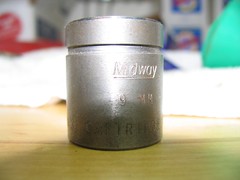
so i got my
Browning High-Power back from the factory a little while ago, cured of its ills. since i had a stack of boxes of ammo i bought for another gun, i used them up instead of rolling my own. now that the store boughts are history, it's time to go back to the round my gun loves best.
since building my reloading bench, i've stacked a ton of reloading stuff on it. here's the pile of bullets awaiting their turn in the press
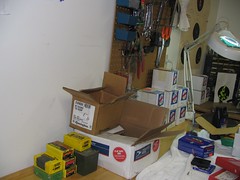
hmm. let's see. looks like about 2000 rounds of 115 grain 9,mm, 2000 200 grain 45 ACP, about 1500 rounds of various weights for the 45 COLT, a 1000 rounds of 170 grain flat points for my 30-30, 2000 125 grain remington golden sabers for the 357, 3000 148 grain hollowback wadcutters for the 38 special, 250 70 grain Speer TNT hollowpoints in .243, and an odd collection of various 9mm i experimented with.
actually, i'm guessing at quantities, because a lot of the boxes have been opened and used. that's just the "published amount". to see different views of the bullet storage, visit my flickr set
Things that go BANGbefore getting into the actual reloading, let us talk about one of the main components: BRASS. All reloading manuals have tons of info about what to look for in your brass. splits, bulges, blown primers. so i'm not. but there are things they don't tell you.....
a word about cases. i am a range rat. i'm also a scrounger. i am glad there are only a few of us that reload, because the number of folks that just leave their brass behind keep me in reloading components.
BUT you get what you pay for. in this case, there are some things to be aware of when scrounging cases that you haven't actually shot yourself. first, if it's an aluminum or steel case, leave it there. neither one is designed to be reloaded and are single use casings. if the case is creased on the sides, leave it there. you don't need the potential for damage or injury from using a weakened case. if it's military, leave it there. usually you can tell a military round because even if there is something stamped into the head, it probably won't be the caliber. why not use military casings? the primers are crimped in place, and to remove the primer and swage out the crimp is a pain in the ass, and the gear needed is just another expense for a sometime used piece of equipment. there are usually so many ammo casings left behind by others that dropping the military stuff isn't painful at all. why do you care if the primer is crimped in? you can damage your decapper, and possibly damage your primer assembly repriming. a visual, if you please. i took one military case, decapped it, and attempted to prime the shell to demonstrate the typical outcome of using military brass that hasn't had the pocket reswaged. here's what usually happens when you do that:
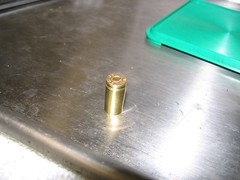
see the primer? note that it is cocked, and is far from laying flush in the pocket. think you can shoot this? think it will even feed? here's another view

one last casing thing to talk about. i never pick up Sellier & Bellot cases

not because the cases are bad. quite the contrary. this is great ammo, and it's usually pretty reasonable. but in 9mm, the case head shape just doesn't work in my press. they are tapered or something. whatever it is, they don't run in my standard 9mm shellplate. love the ammo. my browning has never failed once using S&B ammo. hate the cases. my RCBS ammo-master progressive press goes funky when i feed them. for all the case issues, i have a quick and easy check. i always look at the case head and sides before putting in the shell plate. it's a lot faster than it sounds. any that don't measure up, or have other problems like the ones i've discussed end up in the garbage. and i check every single case before putting it in my press. every time. without fail. it's my hands holding the gun those things are going into. or worse, it's my wife's hands, or those of my kids, or even friends that go shooting with me. so yes, take the time to be careful. it really doesn't take any time at all to be safe.
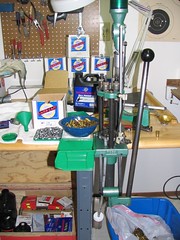
here's the press, set up for reloading 9mm ammo. casings, bullets, and powder scale at the ready, it looks like it's time to LOAD!
so for this ammo, i am using
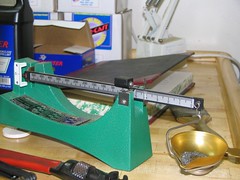
4.1 to 4.2 grain of Winchester 231 powder and Winchester small pistol primers.
I'm also using Oregon Trails lasercast 115 grain hardcast lead round nose bullets.
all of the prep work takes time, so that first thrown bullet is a reward.
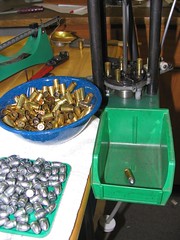
when reloading, most sizing dies will straighten out a lot of the case mouth deformations one will find with scrounged ammo. just don't use dinged cases. bad juju. here's an example of a flattened case that presents no problems reloading. this is a very mild deformation, and most presses can handle much much worse. it's in station 1 the lowest of the cases in the image
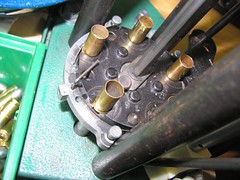
a little patience, and before you know it
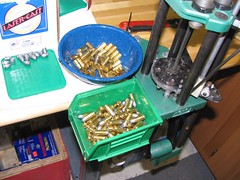
you've loaded 100 rounds. that's all the primers my primer tube will hold. and this took about 20 minutes from start to finish. excluding all the prep time, of course. from here on, it will take around 25 minutes per 100, simply because the primer tube needs feeding.
when building ammo, the first thing i do is measure the first 3 rounds for powder weight. then i check about every 20 rounds or so. the second thing i do is check for overall length, in this case 1.10 inches
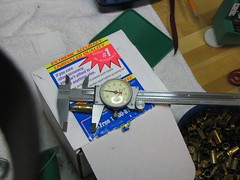
and whether or not if fits in the go-no-go gage or not. the 9mm luger round seats on the case mouth, so crimp and length are important, and a go no go gage is the way to check them easily and quickly.
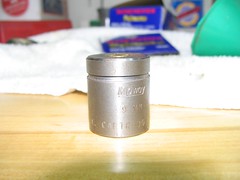
see the round's head in the center of the top of the gage? this is a well constructed round. taper is sat, no bulges, and the overall length is within SAMMI specs.
after throwing 100 rounds, i check all the rounds by standing them up in a metal tray. this will tell me if there are any problems with seating the primers deep enough. important in an auto, even more so if loading revolver rounds. a shallow primer could cause the weapon to malfunction, or even worse.
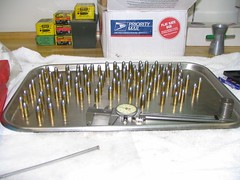
. do i do this for every round? short answer:
YES.
next, i box my ammo, or put it into ziplock bags.
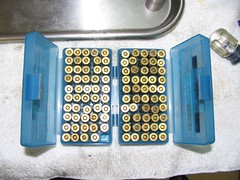
check out this closeup.
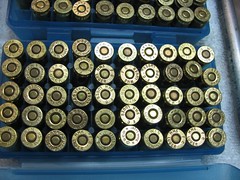
go look at the large or original size. note there are many brands of casings. purists would have you separate out the cases by manufacturer, and have distinct loads for each provider. as my dad used to say BUSHWA. maybe, just maybe, if you spend a zillion dollars on a super whammodyne buck rogers space gun capable of inserting lead suppositories in gnat alimentary canal exits at 50 yards, ok. but after reloading for a year, and religiously sorting out the various brands, i did a little experiment. remember, i'm using a gun that on a good day will hit minute of barn at 50 yards. i built some sorted rounds, and then some mixed brass. guess what? couldn't tell the difference. then a couple of months later one of the gun mags had an article by a reloading guru, and he had come to the same conclusion. so don't sweat the unimportant stuff, spend your time building safe, consistent ammo.
so what did a couple of hours in the shop get me? how about 700 rounds of custom built, kick ass, consistent ammo to blaze away with. that's what it got me.
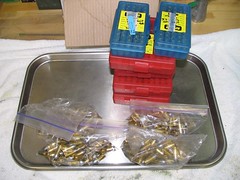
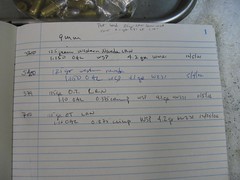
and since i'm such a geek, i always try to keep track of the ammo i've built. this is a new book, started in 2001 when the other was filled. you know what they say... it ain't done until the paperwork is finished!
and while reloading i listened to the following cds
music to reload by
DJ Shadow: Preemtive StrikeMike Oldield: Tubular Bells 2Bad Company: 10 from 6Pink Floyd Meddleedit: went back out and reloaded some more. 200 rounds of 9mm, and 300 rounds of 45 acp with 200 grain oregon trails semi-wadcutters. once you get going, it's hard to stop.
tunes to reload by redux:
Tom Waits: Closing TimeAndreas Vollenweider: White WindLeo Kottke: Standing in My Shoesand finally
Putumayo Presents Acoustic BrazilLabels: 9mm, ammo, Browning Hi-Power, guns, reloading